


Why Ceramic Heaters Are Ideal for HVAC Equipment Manufacturers
- Mar 11
- 5 min read
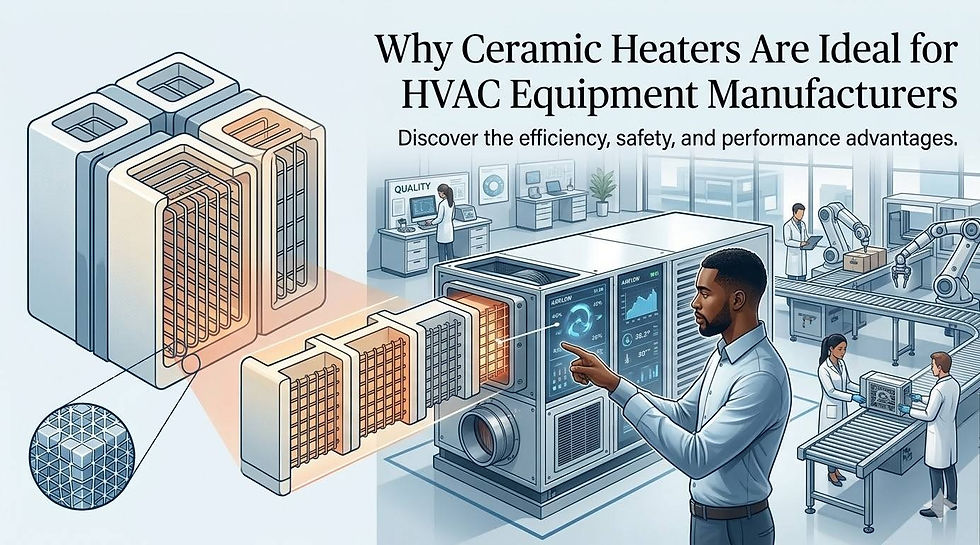
The HVAC industry is currently undergoing a massive transformation driven by the global push for energy efficiency and the miniaturization of electronic components. As equipment manufacturers strive to build units that are smaller, quieter, and more reliable, the choice of heating elements becomes a critical design decision. While traditional metal coil heaters have been the standard for decades, ceramic heaters have emerged as the superior alternative for modern thermal management.
Ceramic heaters, particularly those utilizing Positive Temperature Coefficient (PTC) technology, offer a unique set of physical properties that align perfectly with the needs of original equipment manufacturers (OEMs). From self-regulating safety features to high power density, these components solve many of the engineering challenges associated with traditional resistive heating. This article explores the technical reasons why ceramic heaters are the ideal choice for HVAC equipment manufacturers looking to innovate and provide value to their end users.
Understanding the PTC Advantage
The primary reason ceramic heaters are gaining traction in the HVAC sector is the science of PTC ceramics. Unlike traditional nichrome wire heaters that maintain a relatively constant resistance regardless of temperature, PTC ceramic materials exhibit a significant increase in electrical resistance as they heat up. This characteristic creates a self-regulating effect.
When a ceramic heater is first energized, it has low resistance and draws a high amount of current to reach its operating temperature quickly. As the ceramic material reaches its transition temperature, the resistance spikes, and the current flow drops automatically. For an HVAC manufacturer, this means the heater acts as its own thermostat. This inherent safety mechanism reduces the risk of overheating and prevents the "red hot" conditions often seen in wire-based systems. By integrating a Wholesale Ceramic Heater into the design phase, manufacturers can simplify their safety circuitry and reduce the number of redundant thermal cut-offs required for certification.
Superior Energy Efficiency and Thermal Response
Efficiency is no longer just a marketing buzzword; it is a regulatory requirement. Modern HVAC systems must meet stringent seasonal energy efficiency ratios (SEER). Ceramic heaters contribute to these goals through their rapid thermal response and high efficiency in heat transfer.
Ceramic materials have excellent thermal conductivity and a high surface area to volume ratio. Because the ceramic stones or plates can be shaped and finned, they transfer heat to the passing air much more effectively than a thin wire. This allows for lower operating temperatures on the surface of the element while still achieving the desired air temperature rise. When the heating element operates at a lower temperature, there is less wasted energy through radiation into the heater housing, and more energy is directed exactly where it is needed: the airflow.
Furthermore, the fast heat-up time of ceramic heaters means that the HVAC system can reach its peak operating efficiency within seconds. In contrast, traditional metal heaters often require a longer warm-up period, during which energy is consumed without providing immediate comfort to the occupant. For manufacturers of heat pumps or hybrid systems, this responsiveness is a major selling point.
Compact Design and Space Optimization
The trend toward urban living and smaller mechanical rooms has forced HVAC manufacturers to shrink the footprint of their equipment. Every square inch inside a furnace, air handler, or portable climate control unit is valuable. Ceramic heaters are significantly more compact than their metal counterparts for the same power output.
The high power density of ceramic heating elements allows manufacturers to pack more heating capacity into a smaller space. This is particularly beneficial for duct-mounted heaters or auxiliary heat kits used in electric vehicles and residential heat pumps. Because the ceramic elements do not require the same clearance distances as open-wire heaters to prevent arcing or fire hazards, engineers can design tighter, more efficient internal layouts. This space saving often translates into lower shipping costs and easier installation for the end user, providing a competitive edge in the marketplace.
Enhanced Durability and Longevity
HVAC equipment is a long-term investment for consumers, and reliability is a core metric of brand reputation. Traditional heating coils are prone to oxidation, sagging, and mechanical failure over time. As the wire expands and contracts through thousands of heating cycles, it becomes brittle. Eventually, the wire breaks, resulting in a complete system failure.
Ceramic heaters do not suffer from these degradation modes. The ceramic material is chemically stable and does not oxidize at operating temperatures. Since there is no thin wire to fatigue, the lifespan of a ceramic element is often measured in tens of thousands of hours. Additionally, ceramic heaters are resistant to humidity and many environmental contaminants that would cause corrosion in metal coils. By utilizing a Wholesale Ceramic Heater source for production, manufacturers can ensure a consistent supply of durable components that lower the total cost of ownership for the consumer by reducing the frequency of service calls and parts replacements.
Safety and Fire Prevention
Safety is arguably the most compelling reason for manufacturers to switch to ceramic technology. In many traditional HVAC systems, if a blower motor fails and the airflow stops, a metal heating coil will continue to get hotter until a thermal fuse blows or a fire starts. The red-hot wires can also ignite dust buildup or nearby plastic components.
Ceramic PTC heaters are inherently safer in "no-flow" conditions. Because of the self-regulating resistance property mentioned earlier, if the airflow stops, the heater's temperature will rise slightly, causing the resistance to climb so high that the current draw becomes negligible. The heater essentially reaches a state of equilibrium where it cannot get any hotter, even without air cooling it. This "fail-safe" nature significantly reduces the liability for manufacturers and simplifies the compliance process with safety standards like UL or CE.
Improved Air Quality and Comfort
End users are increasingly concerned with indoor air quality. Traditional electric heaters often produce a "burnt dust" smell when they are first turned on after a period of inactivity. This happens because the high surface temperature of the wire coils incinerates dust particles in the air.
Ceramic heaters operate at lower surface temperatures, which avoids the combustion of household dust. This leads to a cleaner-smelling and healthier indoor environment. Moreover, because ceramic heaters provide a more consistent and stable heat output without the extreme temperature fluctuations of on-off cycling found in older systems, the comfort level for the occupant is much higher. The heat feels "softer" and more constant, which is a hallmark of high-quality HVAC equipment.
Cost-Effectiveness for Manufacturers
While the initial unit cost of a ceramic heater might be slightly higher than a simple nichrome wire, the total system cost often decreases. When you factor in the reduced need for complex control electronics, fewer safety sensors, smaller housing requirements, and lower warranty claim rates, the economic argument for ceramic becomes clear.
Manufacturing processes for ceramic heaters are also highly scalable. OEMs can work with a Wholesale Ceramic Heater provider to develop custom shapes and sizes that fit specific equipment geometries. This flexibility allows for modular designs where the same basic heater platform can be used across multiple product lines, further reducing inventory costs and engineering overhead.
Conclusion
For HVAC equipment manufacturers, the transition to ceramic heating technology is a strategic move toward modernizing their product offerings. The combination of self-regulating safety, energy efficiency, compact sizing, and long-term durability makes ceramic the ideal thermal solution for the challenges of the 21st century.
By prioritizing the integration of ceramic components, manufacturers can produce equipment that is not only safer and more reliable but also more attractive to a market that values green technology and intelligent design. As regulations around energy consumption continue to tighten, the manufacturers who have already mastered the implementation of ceramic thermal management will be the ones leading the industry forward.


Comments